Sunday, May 24, 2026

All the spices of Arabia

I have lived in Saudi Arabia for 15 years. During this time, I haven’t seen them generally grow any perennial spices, though they do cultivate a few herbs for their culinary needs and home remedies. However, they do know and have all the condiments and spices they need in their traditional markets, let alone in modern-day department stores and shopping centers downtown, where they have all the fruits and vegetables from around the world. I have often spent time counting the variety and number of items offered at such spice stores. They just don’t sell the items for their Arabian coffee or ‘Qahva’ as they call it. They have everything, and many of them, interestingly, have their origin in India, but I haven’t seen them in India. I must keep my eyes open wide enough to see all that is there at home first. William Cowper knew that variety is the very spice of life. What is then the variety of spices?  


I can name a good number of them, but not all. If you would like to challenge yourselves, please zoom in and list them. If you get 90 out of 100, you are an expert. It includes many of the ones we used to grow at home in India when I was growing up. To my surprise, as we went shopping for a party, the shopkeeper I know showed me a sort of dried moss with feathery, exfoliated strips of bark from some plants. It is a sort of dried moss, and it comes from India. My mum has no idea of its culinary use; my grandmother probably didn't even care for it. But it adds flavor and fragrance to Kabsa. We tried it and loved what it added to the food we made with it. Much later, I realized that it is a lichen, often found on tree trunks, especially on areca nut and jack trees, where I come from. A modern art piece featuring symbiotic artwork with algae, moss, or cyanobacteria, with mysterious brushstrokes. Ms Mangala, a senior teacher I recently became acquainted with, told me that the absence of lichen is a key indicator of air pollution in the locality.

In such shops, seasoned masterminds know each of their long-term customers' tastes and preferences. They prepare the ready-mix powder for any dish on demand, measure, add more or less of their chosen ingredients, sift and grind, and then pack it airtight, with special instructions for use and storage, all the while exchanging news from their villages and towns. Customization is not a new marketing gimmick in those traditional markets. It is a lifelong bond, and they are a family.

Saudis may be using it to add spice to their lives in the desert, where they live by rearing sheep and camels in otherwise hostile climatic conditions, with the weather becoming extreme for most of the year. Dried ginger, sesame seeds, cinnamon, coffee husks, turmeric, cardamom, dried limes, mahlab, mastic, nutmeg, rosewater, shaybah, blackseed, black pepper, dried rose petals, dried onion, saffron, flake seeds, sumac, tamarind, zatar, cloves, cumin, mint and nigella seed make up that long list. You may buy most of them either ground or unground. 

They know the friends and foes of their catch, so they do not even carry them home all in the same package. The same rule applies in use, too. Certain combinations are not supposed to go down together through the throat. Don't go and quiz them on amensalism, incompatible food (virudha ahaara), or food taboos, though. As the popular saying goes, the spices are the poetry of the kitchen, and the same spices help us decode the history of our civilization. The Nutmeg’s Curse by Amitav Ghosh is just one case in point to explore in this regard.

Sunday, February 22, 2026

"Until one has loved an animal, a part of one’s soul remains unawakened"

      "Until one has loved an animal, a part of one’s soul remains unawakened"  Anatole France, the Nobel Laureate in literature in 1921, cannot be wrong. I have no idea whether he has kept an animal, but I firmly believe what he said is true. As we moved to a new house not far from where I was born and brought up, I took many things with me that I held dear. It includes various collections, such as books, stamps, coins, letters, tools, plants, and the like. However, it was not easy to leave behind many of the domestic animals we grew up with, like goats, rabbits, chickens, cats, a dog, and countless wild ones.

However, it has been a rustic idea to introduce chickens, ducks, or rabbits to our backyard in a newly settled neighbourhood. There was no proper fencing in place to enjoy the status of a nice neighbour. Nor did we like the idea of raising them in confinement. But the idea that there must be some animals living around us, sharing our yard, began to knock inside me to an irresistible frequency. Without thinking much, we tried our luck with ducks in 2021 with a small flock of two drakes and four hens, as I was forced to enjoy a longer vacation at home due to the COVID-19 lockdown and couldn't fly back to work.

         It was a beautiful scene, they forage for grains and insects with their extended bills across the yard. Quick were they in sensing both prey and predators. They were profuse layers, and my kids enjoyed their wacky ways and chased them from a makeshift, pond-like water hole, fluttering both their wings, holding them straight up, standing vertically to shake off the water droplets, easing them from the weight of the drench, and grooming themselves perched over a boulder, log of wood or a raised veg patch. One among the flock was a Vigova, the big, white, muscular beauty among ducks from Vietnam. Interestingly, Vigova was bred by interbreeding to meet the needs of war-torn Vietnam. They made the best use of deserted waterlogged trenches dug during the war and thankfully fed the people back to health. He commanded the flock

    We had one to five eggs almost daily, even to share with neighbours, unless it rained incessantly. That was an educational experience for kids. Kids became curious and looked up more about their newfound winged friends, and came up with wide eyes full of new knowledge: that ducks have a field of vision of up to 340 degrees and a blind spot of 20 degrees behind their heads. However, that love affair didn't last long. The authorities eased the regulations, and the airports reopened for international air travel. We packed up, gave the ducks away to one of the neighbours, and flew back.

    As I settled back home again, the same thoughts revisited, and this time, we started with rabbit. The first batch came with a New Zealand white mom and her six adorable kittens with snowy white coats and bright pinkish eyes. Neighbors came to visit as if we had a new born, some came with carrots as treats to the hutch. Ansu later found out that it is only a popular myth that carrots are the natural diet of rabbit planted by cartoons and that is not true. When I was a child, our rabbits never knew what carrot was. That rabbit too didn't last long, as the rabbit hutch smelled foul and attracted rat snakes driving my wife crazy and kids were terrified to see rat snakes tattling trapped in the safety net. Having learned the lesson hard way, that nothing works without family support. That left with  me with one option to give them a farewell. The pet shop was happy to receive them back but my eyes caught hold of another one across the cages on display. I will be back soon for you.

Tuesday, December 24, 2024

Who is Howling in Arabian Nights?

It must be a wolf on a chilling night. The descendant of the one who smelled the blood of the prophet Yousuf. His brothers threw him into a well and lied to their father that a wolf had killed him—the one who undeservedly bore the burn of the blame among all the animals of the desert. We are so quick to assume Arabia is an astronomical stretch of sandy dunes margined by horizons. But it is not like that everywhere, especially in inhabited areas, places of settled life near water holes, valleys, and places where caravans used to meet their suppliers and buyers along the trails in the past but have grown to be modern-day towns.


I read Alfa Layla Wa Laylah (Thousand Nights and a Night) in Malayalam copy I borrowed from the college library. I did enjoy it myself. I owned a copy of my own in English much later in 2003 from a used bookstore in Kozhikode. Last week, my son had heard something about a tale from his school and came home asking if I had any such a book in our collection. "Home is where books are” Richard F. Burton cannot be wrong. I remembered mine and rushed upstairs to grab it, hoping to make the best of the kids eager to read. Only to find the copy lying on the table unattended sooner to my disappointment. Naturally, I craved a revisit and went through it settling on “When It was 18th Night”.  Burton had given a footnote for a sentence “She was delighted and clapped her hands, whereupon a door was opened.”

The footnote goes thusly. “I need hardly say that in the East where bells are unused, clapping the hands summons the servants. In India, men cry “Quy hey” (Koi hai?) and in Brazil whistle “Pst!” after the fashion of Sapin and Portugal.” In Kerala, where I am from, it sounds more like “Kooi” often inviting someone’s attention or in the past, requesting the boatman at a ferry to wait a little while the man so close rushes to board the boat. The same whistling language was once used to declare the sighting of the moon confirming Eids or Ramalan, the holy month of fasting, as well as the local match victories, festivals, and childbirths.

Burton has always surprised me. Nothing he has penned is more wonderful than the very life he lived as his own.  Among numerous adventurers, he had undertaken a Hajj pilgrimage in disguise and made erstwhile classics like Kama Sutra (1883), The Perfumed Garden (18860 and Arabian Nights (1885 -1888) available to the English-speaking world. He lived his words in a way, with all the controversies around his life kept under the carpet. As 2024 is about to bid adieu, I remind myself of Burton “Conquer thyself, till thou hast done this, thou art but a slave; for it is almost as well to be subjected to another's appetite as to thine own. Starting in a hollowed log of wood — some thousand miles up a river, with an infinitesimal prospect of returning!” I wish the same to all my readers. Merry Xmas. Happy Cake Day and New Year.

Tuesday, September 3, 2024

You, the drunkard!

What are you fathoming, entirely focused, risking your awareness of your surroundings? This is the first time I've seen you dive deep into flowers to gather nectar. Your resilience in the face of potential predators is genuinely inspiring. Are you so engrossed in your work that you're distracted? Where do you go after you're done? Why are the flowers so stingy with their nectar, making your job more challenging? Why do you venture out alone, without your friends to keep watch, as you dive blindly into the center of the flower?

Hey, Zinnia! I hadn't fully appreciated your beauty until you were in full bloom. You’re a true marvel in full bloom! Make the most of the sunshine, dear flower! You're thriving in the light, and it suits you. Keep growing and flourishing. It doesn't feel like a chore when we're passionate about something. While theory and practice may differ in many ways, that's alright. You're still reaching your full potential, even if it's not exactly as expected, and that's what matters.

As I walked to my office, I stopped to take a photo like this. It's a moment that celebrates the beauty of independence - a treasure often appreciated most by those who have been deprived of it. The welcome message isn't audible but rather a silent language that resonates within your own neural pathways. The chemistry we share, the subtle scents you emit, and the vibrant colors you display all combine to create a captivating magic that draws me to you. Who's to say what's to blame and what's not?

Does it impact the food supply for animals, often considered thieves, when you collect nectar? Only plants can produce food through photosynthesis, and you play a crucial role in supporting them. While it may seem like you're stealing their honey, it's actually a mutually beneficial arrangement. Plants rely on you for pollination services; the nectar is your payment for a job well done. It's a remarkable and wondrous partnership. Keep up the good work! I'll catch up with you later.                                                              

I'm sure you're omnipresent and the primary beneficiary of photosynthetic sugars before plants transport them to their roots through the phloem. It's as if they're allowing you to be the first to savor the sweetness, like a corporate ice cream taste-tester. You get to enjoy the fruits of their labor before anyone else!

I recently heard that 80% of flowering plants rely on your species to reproduce and pass on their genetic legacy. You may not be familiar with the concept of deep ecology, which we frequently discuss at our international seminars. However, you embody the principle of 'actions speak louder than words' and excel in your role. As Stephanie Skeem aptly said, 'Flowers don't tell, they show.' Honeybees like you also demonstrate this wisdom. Our collaborative work has a lasting impact on the world we share. You come to mind whenever I hear about the so-called 'lifesavers' like herbicides, fungicides, and insecticides. May human actions spare your species, allowing you to continue your remarkable legacy.

Monday, July 22, 2024

Call me meow meow.

           Cats are cats; by any other name, they act like cats only. There are plenty of cats down the streets, and interestingly, a dictionary defines cats as an animal popular in the Middle East and Africa. Cats are usually very photogenic, and our archives have plenty of such pictures. But this one is not seen around here; he behaves as if he owns all the land and is in charge of the welfare of the entire neighborhood. I didn’t care either. Our neighbors Yahya and Jawahir are avid feline philanthropists feeding all the cats around with store-bought cat feed. She has set up a few labor rooms for cats to give birth and for maternity care. She doesn’t mind the thankless demeanor for which cats are notorious.


I sat on a stack of hollow bricks listening to an audiobook, Nature Fix by Florence Williams. I usually enjoy doing so during summer nights after strolling down the deserted driveway well-lit by a tall lamppost down the street yet to be called by that name. He, too, showed up from nowhere and sat by me, commanding control and authority on me. I had trouble reading his look clearly, but he settled down gracefully. I kept listening. After some time, he stood up with his tail held high and ears kept alert. The corner had obstructed my view of what he had his eye set on. Then he dashed to a few rocky boulders heaped around on the other side of the street in haste. I got up, driven by curiosity, only to see a street dog with a well-manicured medium white coat approaching.

The dog read my face and took a detour to access the other road leading to the neighbor’s house two blocks across. My face must not have been looking friendly. No sooner did the dog disappear than the cat took the spotlight and continued lying in the middle of the street as though nothing had happened. What a brilliant little, cute, four-legged, versatile gymnast you are!

Sunday, December 24, 2023

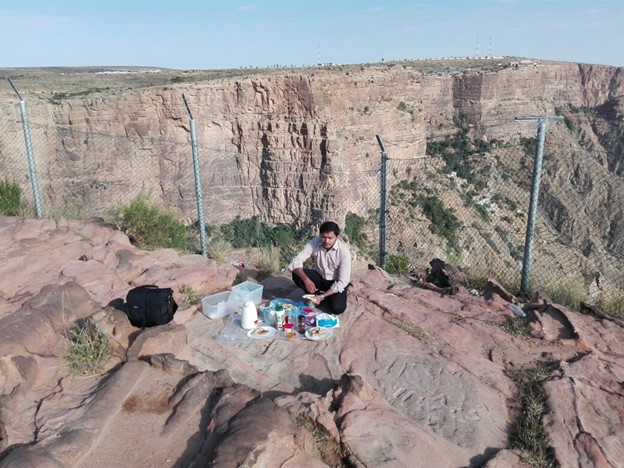
A Breakfast with Elements at the Heights of Habla

       There was a time when I lived in a sleepy, cold town all alone, having the luxury of a lovely friend, a small car, and a camera. We roamed around the places, exploring things no mortals we knew ever dared to. Once, he came up with a plan to watch the sunrise and had breakfast sitting on the top of a huge boulder, crowning the edge of a mountainous height and cutting steep slope that people feared to peep down. The mountain peak known as Habla is one of the peaks on the Aseer Mountain range, which is part of the Sarawat Mountains, running parallel to the Red Sea’s eastern coastline, extending the Hijaz Mountain range to the Southern borders of Saudi Arabia.


     Part of the plan was to start way earlier so that we could watch the sunrise, and December was never kind to the people of this part of the world. Being so precarious and knowing much more about what was happening around me, I said no without sounding blunt. Still, I had to follow his mind; what happened afterward was a once-in-lifetime experience. It was rather like meditation. And a simple but sumptuous breakfast. My crazy friend had packed everything diligently to keep it hot as the weather was chilling, and the cold breeze never stopped blowing on our faces, facing the sun for mercy.

     A strange, mystic sort of elevating experience swept us into an unearthly trance. Maybe because it was a Friday morning, all the monkeys remained in the cliffside holes, usually fast asleep, daring not to disturb my Buddhist Sufi, Erich Beer.

      Here’s a word about breakfast. As one of the main three meals of the day, breakfast has always been stressed as more important than the other two. The saying goes like eat your breakfast like a king, lunch like a queen, and dinner like a beggar. However, I recently heard about a book being reviewed on BBC World that says breakfast is a dangerous meal. I don’t know why. Nor did I dive deeper into it to get to know it. It may be a cognitive bias that I don’t want to believe that story, even if the author succeeded in convincing me otherwise.

Friday, December 1, 2023

The Earth in Her Hands

 The Earth in Her Hands is a book by Jennifer Jewell that covers 75 extraordinary women in the world of plants. It tells us stories of womenfolk who put their life into plants, or the plants chose them to live their life with. Like most exciting things happening in my life, I stumbled upon this title recently while researching a related project online. It was love at first sight, and I got addicted to it while listening to the book on Audible, waiting outside our university dental clinic for my wife to have an appointment. Thanks, Dr. Abdul Qadar, for a three-hour long session on an emergency basis before he leaves for his home for the annual vacation.


Each woman has a unique plant journey to relate to, which will take us for a ride through the ever-exciting botanical world. They are cherry-picked from various fields like botany, garden nursery, floral design, garden, photography landscape architecture, farming, seed banks, herbalism, and food justice. The common thread all these extraordinary lives share is their love for plants. The book has interestingly featured a bold lady from India: Vandana Shiva. She is known as Gandhi of Grain.

Back where I work, the Saudi Green Initiative and Middle East Green Initiative are already on the way to regreening the desert. Saudi Arabia is planting 10 billion plants to help regreen a joint target of 40 million hectares of degenerated land. For a country almost the size of Western Europe and with 2320 miles of untouched shorelines, finding space for these 10 billion is a piece of cake. But watering them can be the only challenge with poor rainfall.

We started challenging ourselves to pick up the litter down the street and clear the undergrowth first. Then, we visited a few nurseries to collect the plants on our list with just two conditions: they must bear fruits edible to men or birds. And it should grow independently once it has established itself fully rooted out. It may last a lifetime, being drought-resistant and winter-hardy. During our nursery visits, we made some compromises, fearing the price tag and being inadvertently influenced by the winning eloquence of the man in charge to sell the least moving and most profitable items in stock. Our behavioral economics is still in its infancy, no matter how educated we think we are. We collected manure from the sheep farms, got help digging the holes and planted by calling anyone available.

My Saudi neighbor Yahyah and his wife Jawahirah looked more enthusiastic about it than I did. I just took the initiative, but they seemed to be doing the rest of the work, like setting up drip irrigation pipelines and extending the work to the next level, traveling around to look for more and better cultivars for their garden space and beyond. Indeed, as the Chinese would say, the best time to plant a tree was 25 years ago, but the second-best time is now.