Thursday, December 25, 2014

One Dollar and Eighty-seven Cents.That was all.


     As we prepare to bid farewell to 2014, with another Christmas warming our hearts and hearths, I want to share the following reflections with you.
     Someone asked me recently how I celebrate Christmas (or I might have brought it up myself). Not sure how or why, but it made me look back at my college days. I fondly remember exchanging gifts with a special person in my life and enjoying a piece of cake in good company. However, this only partially answers the question, at a certain - social - level. At a deeper level, two beautiful stories come to mind, ones that (to me) are inextricably bound up with Christmas.
      The first story is "Christmas Day in the Morning" by Pearl S. Buck, which I first read during my school days. The second is "The Gift of the Magi" by O. Henry, which I read while I was at college.And both of these authors are my life favorites ever since.
     I keep revisiting them even now. Every Christmas is a call for the annual ritual of reading these two beautiful pieces of nostalgic romance, if I can call them so. It elevates - festoons - my mind, spirit and soul ... and, interestingly, every time I re-read those texts I discover something new in them.
     I read somewhere that the world's scriptures and classic literature all share the three universal themes of Faith, Hope and Love. Both stories I mentioned, each in its own unique and memorable way, fully embody these themes.
     And so my gift to you this Christmas is exactly this: faith, hope and love, the timeless themes throughout human history, and the values that ultimately imbue life with meaning, lighten our load and light up our path on our shared journey.

Merry Christmas!

Tuesday, November 4, 2014

Now, let us focus on focus …


I treat myself to the weekly luxury of going online to indulge my never-ending curiosity. In so doing I recently stumbled upon “Focus: The Hidden Driver of Excellence” by Daniel Goleman. Quite impulsively I clicked the “buy” button, much to my own surprise (as I am naturally thrifty). What’s done is done – but I have no regrets. I have fallen in love with this book and now keep revisiting it. Goleman is mesmerizing with a piercing intellect and a conquering feather touch of intimacy.
Daniel Goleman is no stranger to those in the field of education. His revolutionary work on emotional intelligence has made him an ever shining star among both educators and corporate mentors.

 Practically all of us have gone online only to realize, many hours later, that we have little concrete to show for the last few hours of clicking. There is simply no end to our unchecked online wanderings as we pursue one pop-up and one link after the other. This is an exceedingly common phenomenon in the age of prodigious search engines such as ‘Sheikh’ Google, user-contributed data bases like ‘Imam’ Wikipedia, and a proliferation of posts on social networking sites like Facebook and Twitter. Goleman has something very pertinent to say about this: “Life immersed in digital distractions create a near constant cognitive overload. And that overload wears down our self-control.” (p.31)
If we lose focus so easily in our online lives, it would be safe to assume that we easily lose focus in our “real” lives too – failing to differentiate between the things we have to do and the things we merely want to do.
We all know we can’t get to fully know everything but have to be selective about those things we wish to gain an in-depth knowledge of. For the latter we need focus, and Goleman’s book is an invaluable tool for helping us navigate our waking life, turning it into a wakeful one. As the subtitle says: focus is the hidden driver of excellence. If we want to excel at anything, hard work alone won’t pay off. We need focused attention to prevent our mental energy and attention from being dissipated and squandered by fascinating and insidiously compelling stuff that is not pertinent to our query or our quest. Even worse even, by an irresistible inner chatter. Goleman advises us to “think of attention as a mental muscle that we can strengthen by a workout. Memorization works that muscle, as does concentration. The mental analogue of lifting a free weight over and over is noticing when our mind wanders and bringing it back to target.” (p. 168)
This meta-awareness of noticing when our mind wanders makes all the difference. If you want a “six pack brain”, heed Goleman’s advice: “When your mind wanders - and you notice that it has wandered - bring it back to your point of focus and sustain your attention there. And when your mind wanders off again, do the same. And again. And again. And again.” (Ibid)
The book unfolds in seven parts beginning with “The Anatomy of Attention” and ending with “The Big Picture”. The parts that discuss Self-awareness, Reading others, Bigger contexts, Smart practice, and The Well-focused Leader are sandwiched in-between. All the chapters contain invaluable insights but chapter eighteen alone – How Leaders Direct Attention - would make the book worth reading.
Goleman often goes philosophical, drawing on ecological concerns, anecdotes of visionaries, and his broad personal experience with many respect-inducing minds. All of this makes his work even more readable and insightful. My word of caution to you would be not to take it as just another self-help book printed on recycled paper. Because it is not. It stands off from that commercial line.
“Focus: The Hidden Driver of Excellence” by Daniel Goleman is both a mind- and life-changing work. I dare you to read, and be changed by, it.

Goleman, D. (2013). FOCUS: The Hidden Driver of Excellence. London: Bloomsbury Publishing PLC.

This article was originally published our in-house newsletter and can  be read online at


Sunday, November 2, 2014

Measure them even if you throw away


I am not yet able to sort out whether it is a fact or not that every good chef has got his own thump rules. He uses his own gut feeling for proportionate measurement and timing which is indescribable.


It is  a recent realization to me that  there is a measurement in every creation. Everything that god created keep a kind of symmetry in form, acceleration in movement, proportion in its composition, balance in growth, and making. I think we too need to practice it in every efforts. You may wonder what I am talking. Yes I am talking about our time we spend and things we use to make anything. We know how much and how many of most of the things we use as such or the things we use to make something new. But when somebody asks, we just can't seem to give him a correct measurement of time and stuff used.


Lately, I made a cake and as it happened to be one, I dared to present it to a friend. He  bombarded me with a lot of questions for which I don’t have any answer. I am afraid I must have been mistaken that I don’t want to share the recipe. But that was not the case. I simple don’t know for I didn’t think about it before. I wanted to do something about it and I went for a some measuring cups and spoons. Yes the ones you see in the pictures. To my surprise, one of my friends smelled what I have got in my shopping list before I could put it down for next shopping. Otherwise how he could have thought of gifting a set to me then?


Monday, September 29, 2014

A BC Cake..? B for banana and C for carrot.....

If you want to flatter me by asking how I made it, I am credulously glad to share all what I know about it.But my happiness vanishes as I go ahead with recipe.I just cant say how to do it but show if you are patient enough.

Tuesday, May 27, 2014

Anarkali....You are in full bloom....

It is almost the end of the spring in Abha – and yet all plants are still in full bloom. The pomegranate commands my love and respect. If you asked me why, my ready answer would be: I don’t know. But the question remains for me to answer for myself so I dig deep to find the reason.
    
      My infatuation with this plant and its flowering plumage has turned six this beautiful spring. We started out as nodding acquaintances, but our relationship has ripened into an inseparable intimacy. She has never let me down. As I walk by the orchard, tended by an elderly Pakistani man, she greets me with all her twigs in a nodding gesture, no matter if I stop by for a chat or not. I stand in awe of her beautiful visual appeal, her richness in nutrition and her wide use in natural healing, all of which have made her name mentioned in almost all the scriptures of the world religions.

    Anar is the Urdu word for pomegranate, and anarkali Ø§Ù†Ø§Ø±Ú©Ù„ÛŒ  is the word for its blossom. It seems to me the most romantic of all flowers, more so than the rose. Not only that, but it is also present in the heavenly abode. The word has been appropriated into fashion and dressmaking in India. However, it first brings to mind one of the most romantic characters in the legendary tale immortalized in the Bollywood movie Mughal-e-Azam. 
The movie tells the love story of Crown Prince Salim and one of the court dancers in Mughal Darbar. Anarkali, born Nadira Begum or Sharf-un-Nissa, was a slave girl, believed to have been from Iran originally and to have migrated to Lahore in present-day Pakistan with a trader's caravan. The crown prince, who later became Emperor Jahangir, used to call her Anarkali, showing his passion for her. His father, Emperor Akbar, didn't approve and they fell on hard times, as happens in many great love stories. In one of her masterful dance performances at Darbar she sings:
 "I haven't stolen anything but just loved ... so why should you fret about me?"

Wednesday, April 30, 2014

I wish I could ever be it all !!!

Sorry to say that I am afraid you may feel that I am advertising myself. But I cant resist this request from one of my colleagues. So, this time, please be happy with this guest posting by Erich Beer from South Africa. Here goes what he has got to say in his own words...

My friend Jabir

This guest post is at my request. The topic was unprompted.

I first met Jabir during exam invigilation at the end of the first semester. I was recovering from an illness at the time and feeling really weak. I had to sit down several times during the two hours of the invigilation. Jabir and I exchanged a few bits of conversation during the two hours. When we departed he asked me for my email address and gave me his. He said: Remember, my name is Jabir.

I emailed him almost straightaway to give him some information he had asked for. However, for me it wasn't primarily about the information - I was hoping I would get to know him better. I instinctively knew there was something very special about him. My instincts later proved to have been correct. We gradually established an email exchange over the next few months.

A few months later Matthew Glotfelter, who draws up the teaching timetables as per the instructions of the higher-ups, casually mentioned to me that several teachers from the Mahala campus of KKU had been transferred to the Gregor campus. My immediate question was: Is Jabir among them? Matthew didn't know. I soon got confirmation from Jabir himself and was overjoyed.

Jabir and I gradually got to know each other better over the next few weeks. We shared and exchanged and spent time together. It has been a voyage of discovery for me, a very joyful and immensely enriching one. 

Here are just some of the things I appreciate enormously about Jabir. There are many more but the list would get too long.

He takes himself lightly and has a good sense of humor. I sometimes call him "funny man". 

He has a subtle mind and perceptive insights. He has an interesting take on things.

He is honest, open, kind, generous and compassionate.

He has a few mannerisms (which I won't mention here), all of which I find very endearing.

He reflects on things.

He is not self-important and never promotes himself.

He is simply a fine human being.

He is a dear friend and companion.

I love him very much and feel so privileged to have him in my life.

I will always be grateful for the time we've shared.

My wish for him is the traditional Buddhist one: May he be free from suffering, may he be happy, may he be at peace. Always.
This is an old building complex in  Abha, on the way to Habla. My camera zoomed to its limit to catch this palatial tribal head-quarters off the highway.

Monday, March 31, 2014

Life is a nightrain.....

I still can't remember to my god's glory, the poet who wrote the lines in my mother tongue that can be roughly translated as…
"Life is a night rain.
It would all be over, by the time we get up"
(Jeevitham oru rathri mazha
Nam unarumbozhekkumathu chornirikkum)
Every rain brings this couplet into my mind but always untagged with the name of the poet. I am still looking for him to kiss the soil under his foot. It rained heavily for two days in Abha and we got an additional day on our spring break. In my six years stay in Abha, I have never seen such a big shower on the top of the city before.

I feel like a lazy Sunday morning back home rained overnight. Pouring memories on landscape of mind, leaving me totally wet in nostalgic reminiscence. Splashing muddy water to …we used to tread  on every puddle of water on our way and  back to school. Either side of the road form a kind of makeshift canal for us to build bunds and dams…It drives me crazy as I stroll down the childhood lane.
Even today, it is an exhilarating exercise, interestingly  in the mornings it rained all the night, to visit my plants in the garden, wish them good morning, nurse the sulky ones to smile and pat appreciatively the vigorous ones……as though I missed them all night and was eagerly waiting for daybreak to join them. I know it does make a difference in that day of both me and them. I do it as a kind of romantic ritual of my being.

The colors, moods, and emotional make up of rain do  make me think in tune…it was in a long light rainy night...one of my university friends' father died. It was in the morning  it rained for days flooding all the low lying countryside, the news knocked our door that my childhood friend died. It was a stormy with heavy rainfall midday, I caught fever and tuck into blanket. It was on a stormy rainy evening before sunset I shared an umbrella  to walk to hostel. The sun set half an hour early the evening as I heard it  raining  all of a sudden …….  It was  monsoon and raining all days as I started a new lease of life , we ride all the country on a bike having great time in life as never before and never again…lovely lovely lovely...

Wednesday, February 26, 2014

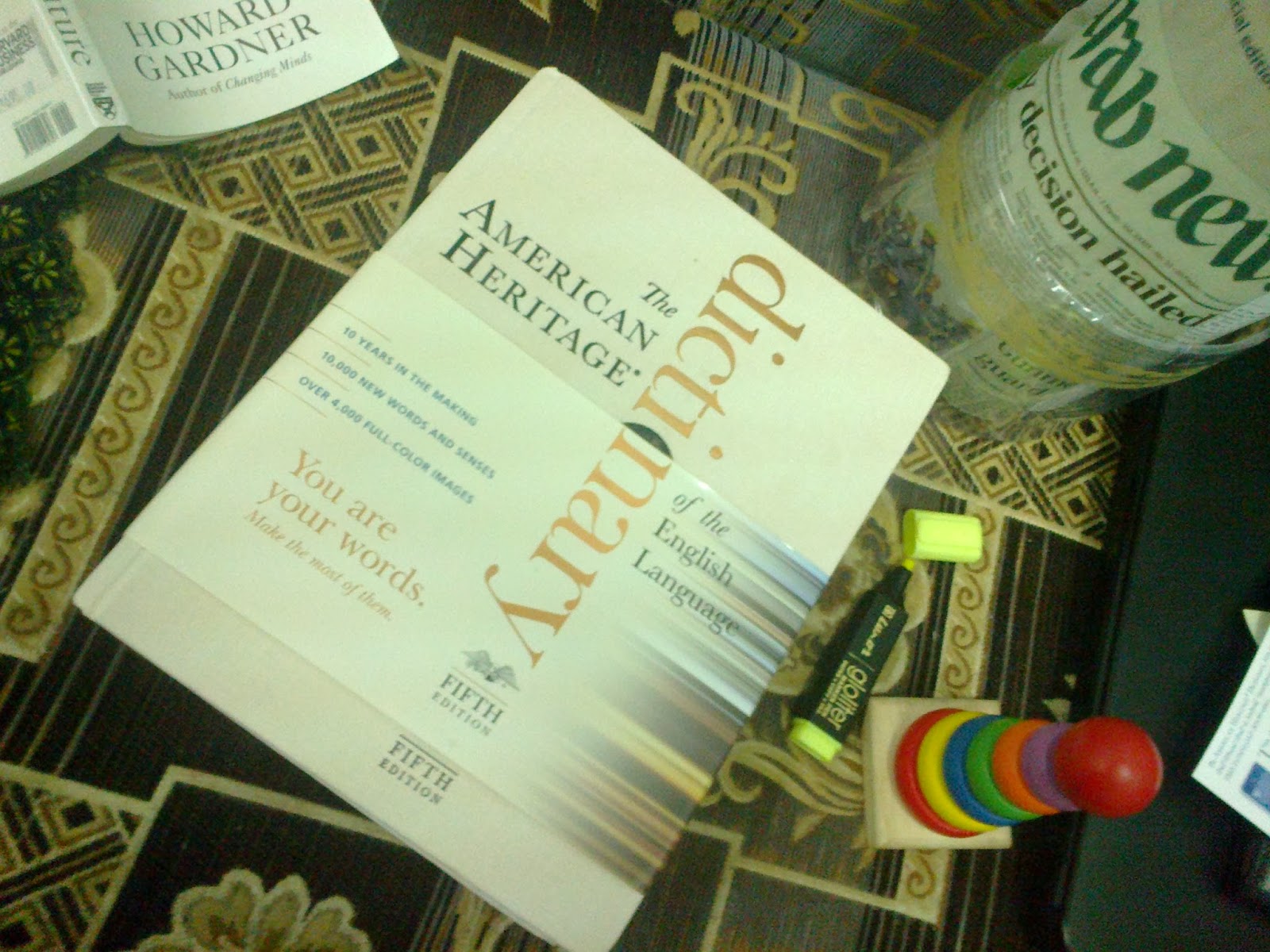
Hats off to Americna Heritage Dictionary of English Language.

You are your words. Make the most of them. 
          So proclaims the cover jacket of American Heritage Dictionary of English Language (AHD). And it won’t take much time to prove it as we start our journey along. We need words for anything and there is a word for everything. Our task is to avail the exact one at the most demanding times. AHD is the name we can trust for that.
     
I owned one only recently. Actually, I was persuaded by my colleague Prof. Gulam Hussain Habeeb to buy one and I gain in gratitude as I keep using it. I hold that Bengali writer in high respect for he translated Five Hundred Years of Solitude to Bengali. To tell you what I feel after I began to use it is amazing. I really fell in love with. As I come home exhausted after a long session in the evening, I find it handy and allow myself wander through its pages. I get to know so many things with pictures that I see around for years but no idea about what to call them in English. I have a strong sense of achievement and enrichment in terms of my vocabulary for a short while now. There is always a sense of pleasure in getting to know something new. I think it is universal.

Professionally, we literature and language teachers are largely well versed in vocabulary related with linguistic, literary, cultural, historical, philosophical, and to an extent psychological ones. But when it comes to popular and scholarly scientific ones or any other major disciplines, a good number of us go clueless. We often have to use an explanatory sentence or two while there is a ready one word exactly for the thing or idea in question. It is a bit embarrassing as we teach ESP for engineering and medical students. There are several reasons for such an imbalance in word power mastery. But that won’t make a good excuse to save our skin. AHD can do a lot in bridging that gap. And as they rightfully claim… we don’t have to doubt my word choice again.

And it comes with a secret code that enables you to download and install the same in your iPad or smartphones once. Be careful that you can’t do it again once it is gone or uninstalled. This digital version makes the 3kg hardbound portable and ready to serve you at any time anywhere offline. We can spend our downtime with AHD’s 2112 pages with more than 4000 color images. They have got a very nice website if you would like to know anything more http://www.youareyourwords.com/

Wednesday, January 15, 2014

Dear Elaine Showalter, You made me feel guilty of what I was not as a teacher !

If I can still take Aristotle seriously for his “well begun is half done” precept, I don’t have to read anything more for the next six months but to reflect on my New Year pick Teaching Literature by Elaine Showalter. A New Year eve with the words of a brilliant teacher and  a few days we hanged around were life enhancing. I know her from my BA final year. She took us the other day to the wilderness. And now to the labyrinthine world of teaching and teaching literature in higher education in particular. She penned it drawing on her 40 years of teaching around the world and we get it in 176 pages.


As I finished reading the book, I felt I should have read it the day I somewhat answered the question: What I want to do with my life?. If I had by any chance, me and my teaching would never have been the same. I think many of my friends read it years back for I read some of them quote her often.

Four years ago, one of my close friends joined a university as an assistant professor. She was one of the well read and scholarly figures among us  even on our college days. However, she sounded like trying to assert her confidence, as I remember, by posting a quote by Showalter on Facebook:
 
" Teaching literature is not a brain surgery. No one will die if we make a mistake about Dryden" (p.ix)
 
 I didn't know it was from Teaching Literature. Nor did I go after it then. I wish I could reproduce the whole book her or at least the last two chapters: Chapter 9.Teaching Dangerous Subjects, Chapter 10.Teaching Literature in the Dark Times, and Conclusion:The Joy of Teaching Literature. They really electrified the teacher in me. I can't go to lectures any more as I did yesteryears any more.