Friday, October 2, 2015


Sunday, May 31, 2015
Amour Vincit Omnia....
Of all the love letters I have ever seen, the most poignant and enchanting ones are from two literary works.You may call it novellas. The first one is Letter from Peking by Pearl S. Buck and the other one is Premalekhanam by Vaikom Muhammad Basheer.I strongly recommend both of them.Especially for those who cant stand a thick volumes of prose fictions.

My dear wife,
First Before I say what must be said, let me tell you that I love only you....( The novel begins with this letter which is something we cant forget for life)
Here is the original work in Malayalam from Premalekanam.

"My dearest Saraamma, When life is at its most intense state of youth,
and one's heart has reached its most beautiful state of love, how does
my dearest friend while away her time during this rare and short-lived
beautiful period of life? As for me, I am living each moment of my life
with my mind stirring hopelessly in love with my Saaraama. What about
Saaraamaa? I request you to think deeply and kindly bless me with a
sweetly generous reply,
Saaraama's own,
Keshavan Nair...." (Translation is drawn from Wikipedia entry)
The work "Premalekhanam" has been translated into English by an Australian writer Asher and published by UNESCO.Thursday, April 30, 2015
Does the desert bleed and bloom at the same time?
The
word “capricious” is often found naturally paired up with the word “desert”. It
took a few years of living in a desert country for me to really understand the
spirit of this union. Mood swings could be a genetically inherited disease for
desert-dwellers. And the desert seems very proud of its capriciousness, so it
never misses a chance to wear it on its sleeves. We may observe the same among
our friends and acquaintances. But none of them appear to be exhibitionistic
about it, whereas the desert is.
The
desert changes its moods more often than its inhabitants. Just think of the
wide range of colors, and the ever-shifting weather, which forces the desert-dwelling
animals, birds, reptiles, and insects into their own survival modes like
aestivation or hibernation. These animals know their habitat best and are highly
adaptable. Hence they make their homes – their own microenvironments – in the
oases, depressions, holes, and rocky inclines. Surprisingly, they are very
choosy about their timing for foraging.
As
we travel through the desert, we can literally see the abrupt changes in
terrain. The type, size, color, sand, rock formations, and soil vary along with
the topography. The weather, too, is no exception. One kilometer can make a difference from shivering
cold to perspiring humidity. In the single diurnal course of the sun, it can be
all of the following, in quick succession: foggy, brightly sunny, stormy,
rainy, breezy, windy, overcast, partly cloudy, clear, and sand stormy.
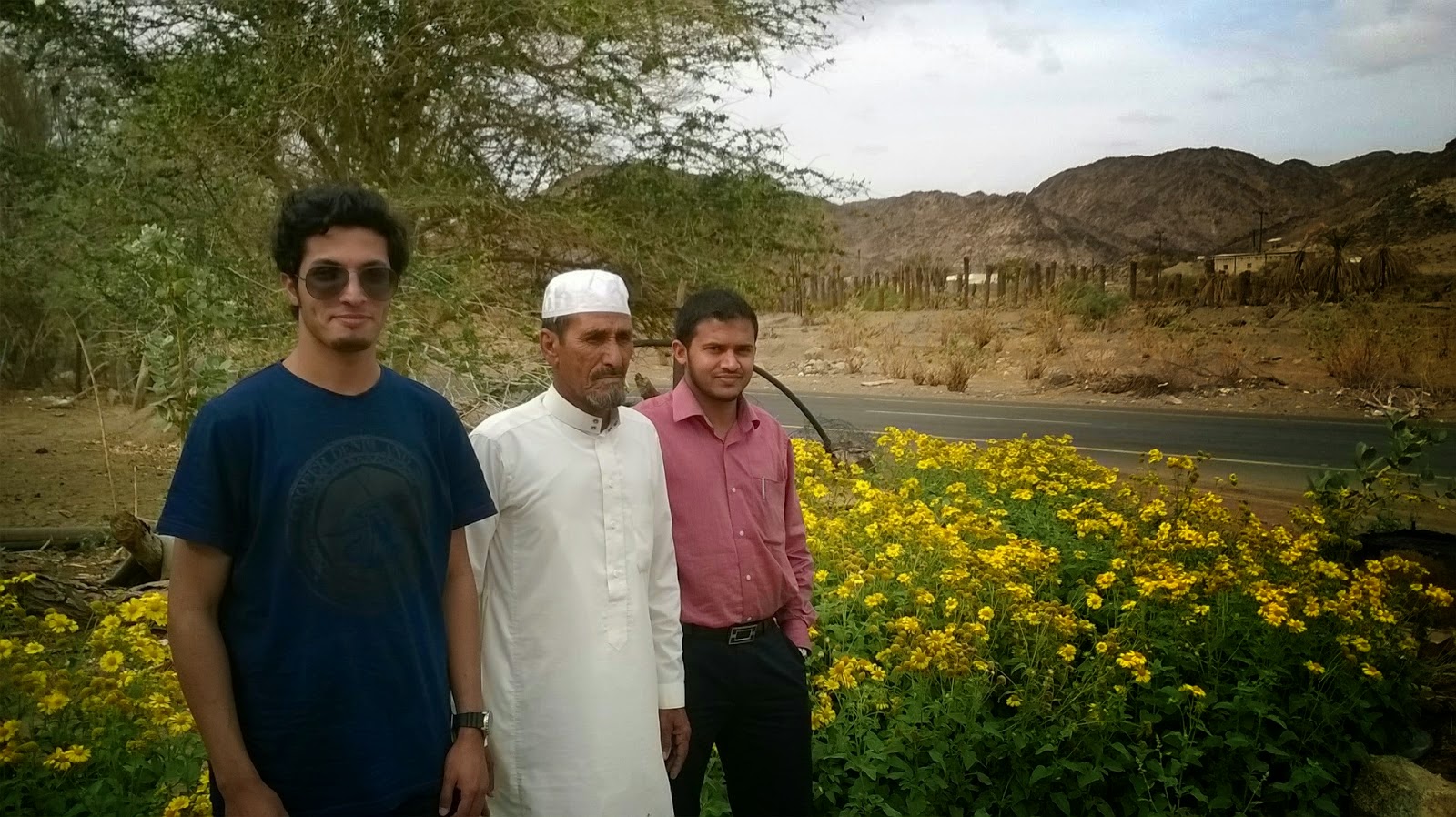
The
image shared is a juxtaposition captured in the southernmost city of Saudi
Arabia called Bisha. The bushy broad bed of yellow flowers is not being cultivated
but grows entirely on its own. It serves up a sumptuous feast for camels’ taste
buds and for the eyes of the beholder. Desert in full bloom. The desert version
of full bloom that is far more alluring than its non-desert counterpart.
This
shot is of a mountain stream instantly formed, born out of heavy rains in
mountains beyond our ken. The gushing water makes its way down the valleys,
devouring everything in its course. It doesn't move mountains, but it does wash
cars, roads, trees, and bridges away, turning people on high alert with
sporting spirit. Men at work and their livestock are often its easy prey. People
in the desert usually revel in rain. They savor every drop of it dancing in the
rain. I have seen people looking down upon me as I hold an umbrella to walk in
the rain. However, flash floods are one of their worst nightmares. Their tribal
defense systems like “kasaba” (a watchtower for early detection of an enemy
approaching their territory) is of limited use in protecting them from flash
floods.
As
I reflect on the desert and its people, I am inclined to think that there is a
desert in the mind of every desert-dwelling man and woman. Each is
symbiotically related to the other. Like the desert, they too change their
minds switching into extremes. Sometimes, so sweet and lovely, at other times
burning with fury. This impulsive approach knows only one of the three degrees
of adjectives: the superlative.
Saturday, March 28, 2015
No teaching without ‘tea’
Every time I take a tea break
during my teaching hours, I ponder how it came to be that “tea” forms the first
three letters of the word “ teacher” or
“teaching”. And ironically enough, no teacher education program ever mentions
even a single word about this. The English faculty at King Khalid University in
Saudi Arabia, where I work, consists of teachers from 15 nationalities. One of
the most obvious common traits I get to notice among them is taking tea. It
provides me with the social proof that at least one thing I do as a teacher is commensurate
with international teaching standards.Hats off to all tea-taking teachers from
four continents. Recently, I was selected as an
invigilator for IELTS examinations. IELTS, as you may know, is co-owned and administered by Cambridge
English Language Assessment, the British Council, and IDP Education. In their
special instructions to invigilators, I found a word of caution against having
tea in the examination hall as the aroma may disrupt the concentration of test
takers. It was something I had never thought of in my ten years of teaching.
Hats off to IELTS for the new lesson on tea.
Recently, I was selected as an
invigilator for IELTS examinations. IELTS, as you may know, is co-owned and administered by Cambridge
English Language Assessment, the British Council, and IDP Education. In their
special instructions to invigilators, I found a word of caution against having
tea in the examination hall as the aroma may disrupt the concentration of test
takers. It was something I had never thought of in my ten years of teaching.
Hats off to IELTS for the new lesson on tea.
Recently, I was selected as an
invigilator for IELTS examinations. IELTS, as you may know, is co-owned and administered by Cambridge
English Language Assessment, the British Council, and IDP Education. In their
special instructions to invigilators, I found a word of caution against having
tea in the examination hall as the aroma may disrupt the concentration of test
takers. It was something I had never thought of in my ten years of teaching.
Hats off to IELTS for the new lesson on tea.Kerala, where I come from, we drink black tea, often flavored with spices like pepper, lemon or cardamom, as a stimulant or as a digestive after a heavy, spicy, high-fat dish like biryani. It is also served as a welcome drink for guests during the monsoon and in winter. In contrast, in Saudi Arabia it is the last course of a feast, with a choice of green or black tea after a heavy “Manthi” (traditional non-spicy rice with mutton or camel meat). According to Wikipedia,“Tea originated in China as a medicinal drink. It came to the West via Portuguese priests and merchants, introduced to it there during the 16th century. Drinking tea became fashionable among Britons during the 17th century, who introduced the plant to their possessions in India to bypass a Chinese monopoly”.Most of the high-altitude areas in Kerala are covered in tea plantations. Hats off to plantation enthusiasts among the Britons.
The tea you could see in the picture above comes in a red tin with a lable that reads “CHINA TEA”. It was a gift for my wife from Dr. Jessy and Dr. Muhsin. It is a kind of green tea very famously known in China and Taiwan as Jasmine tea. It tastes and smells of jasmine with its distinctive aroma and looks green. Initially, I couldn't relate to the idea of smelling jasmine with every sip of tea, simply because I was not used to it. But later I offered it to some guests and they loved it at first sip. It seems to have affected my taste-buds too, to the extent that I am now almost addicted to it. I’m facing a predicament: I have no idea where I can get a fresh supply once the current supply runs out.
Saturday, February 28, 2015
Those Marigold Days
I was born into a world of Marigolds, and grew
up with them. I used to marvel at this romantic monsoon guest in our front yard
garden every year. The display of colors it showcased, the fragrance it spread
in the surroundings, the bees and butterflies it attracted, the very ambiance
it created with its vigorous growth of aromatic rich green leaflets ... what a
carnival this created in my little world of wonder.

When I was in school, I read about terminator genes in our local language science magazine “Sasthrakeralam” for the first time. Terminator genes had been developed by a few wicked scientists. I have no idea if the magazine still exists. At the time, it was a kind of bible for those kids interested in science. It warned about the nightmare the invention could inflict on farmers once the seed companies patented their invention. Not only on farmers, though, but eventually on all of humanity.
The
monsoon was a kind of fajr azan (morning call for prayer from mosques) for
the Marigold in hibernation. All the seeds lying buried under a thin layer of
dust coated in dry leaves emerged after the first drop of rain. The growth of
the vegetation after the first rains blanketed an entire geography in emerald
green. Nothing amazed me more after the daily light, sound and color show of
dusk and dawn giving a backdrop to the day-night transition rituals of every
day. The first drop of rain, the exotic scent of the soil, the variety of
resurfacing herbs, weeds, tubers and creepers majestically accompanied the
return of the Queen.
The
Marigold shows no signs of irritation even though it was disturbed from its
deep sleep. Shooting new leaves with beautiful patterns into the air, it erects
its stem boldly to bear blossom buds. The very experience of watching its
life-cycle from sprouting through to drying in the early spring taught me what
my books couldn’t. Much later in my life, my science mentor Dr. Paul told me
one of his friends had done research on the mosquito-repellent properties of
Marigolds. I recently stumbled upon a website that attests to this fact. Here
is an extract.
“Marigolds
are a great choice for repelling mosquitoes. Marigolds contain Pyrethrum, an
ingredient found in many insect repellents, and they have a unique aroma which
bugs find repulsive. The flowers themselves are beautiful and can make a great
border or addition to any flower bed! Try placing them around borders of your
home, and mosquitoes might not want to cross over!” (Taylor)
Well, last year I brought home and
planted a few Marigold seeds carefully collected from well-grown, mature plants
after their season had run its course, courtesy the Abha municipality
gardeners. That was the way we collected seeds in the village where I am from
in India. To my dismay, none sprouted. I remembered those two ominous words
again after twenty years: terminator genes. Had they been activated here, the
terminator genes my science bible was warning me about? Even in the home garden? Maybe my prayers had
not been heard, or if they had been heard, maybe they had not been granted by
Divine Providence? To what extent will
humankind’s greed for profits make it do things that will eventually take it to
the grave?
When I was in school, I read about terminator genes in our local language science magazine “Sasthrakeralam” for the first time. Terminator genes had been developed by a few wicked scientists. I have no idea if the magazine still exists. At the time, it was a kind of bible for those kids interested in science. It warned about the nightmare the invention could inflict on farmers once the seed companies patented their invention. Not only on farmers, though, but eventually on all of humanity.
‘’Terminator technology is the genetic
modification of plants to make them produce sterile seeds. They are also known
as suicide seeds. Terminator's official name – used by the UN and scientists –
is Genetic Use Restriction Technologies’ (GURTs).’’
http://www.progressio.org.uk/content/what-terminator-technology
I always prayed for it never to come true. You may
wonder why I chose to pray. As a boy from an orthodox middle class family, that
was the only solution I could think of then. Even now it is the best solution I
can think of. Humankind is on a
collision course, unstoppable seemingly – and it will require nothing short of
a miracle – divine intervention – to avert a looming disaster.
Works Cited:
1. http://www.progressio.org.uk/content/what-terminator-technology. n.d. documents. 28 February 2015.
2. Taylor, Janice. http://www.naturallivingideas.com/11-plants-that-repel-mosquitoes/.
13 March 2014. document. 28 February 2015.
Subscribe to:
Posts (Atom)