Sunday, December 16, 2018

The prickliest of all prickly pears…

The name must be sounding like an oxymoron - just like “pleasant pains”. “Prickly” is less likely to make you smile, but the latter half - "pear" - does. Lined up on the edges of each green pad, topped with short-lived flowers showcasing a desert spring, is a feast for our eyes. The wild beauty of those yellowish to reddish flowers allures bees to suck nectar and pollinate, though unaware of it.  

       Call me برشوم (Burshoom) if you find me among Arabs. Some even call me التين الشوكي (Thorny fig).My name tag on a botanical farm reads Opuntia ficus-indica. On Abha streets, vendors sell peeled ripe prickly pears, ready to savor. Go for it once in season. Fans say that prickly pears are rich in antioxidants and a great deal more, leaving me with the impression that their claims are exaggerated. But one thing I know for certain: nobody cultivates prickly pears over here, yet it grows on its own in abundance all around. As such it is perfectly organic.

      If, by any chance, you are tempted to pluck a few invitingly ripe fruits growing by the wayside, your inexperienced hands will regret it in no time. No-one will stop you, nor will anyone rubberneck at you for trespassing. This lovely exotic fruit is fortified with a blanket of invisible, sharp, hair-like prickles. They readily detach themselves from the plant and attach themselves to you. You have no way of knowing this until your skin registers the sensation of being penetrated. It is more irritating than painful. It is almost impossible for humans to avoid being pierced, but camels can.

We have our own tools and techniques to bypass the undesirable part of anything we do or use. We human beings as a race have survived this long only because of that ingenuousness. Popular science books would tell us that most desert plants are thorny to help protect them from predators. 

But the Grand Designer who created the camel outsmarted these defensive designs of his own, letting it snack on cacti, too. I always wondered how camels manage to send their prickly meal down to their stomach. It was only later that I came to know that camels have a set of hardened structures called papillae that line their mouths. These help them eat even the prickliest pads of juicy cacti. If you want to know more on how it works, go ahead at your own risk. Best of luck to your exploratory mind,Click here.

Monday, December 3, 2018

Baking Up A Storm

I love to cook and bake, but prefer baking, and baking sweet things is my favorite. Not overly sweet things, though - preferably somehow fruit-related, and preferably using vegetable oil (not butter) and self-rising flour. I have adapted several recipes to meet these requirements, and have also simplified the steps involved - fusing steps to make it less finicky and time-consuming - with good effect.

Two days ago I made, in succession, apple cake, date loaf and banana loaf, and oatmeal squares, all of them in my mini-oven, using the same kitchen equipment (including the same mixing bowl) and utensils. I used to be frustrated by burnt baked goods (because the oven is so small and the heat so direct, it was VERY difficult to get baked goods not to burn, especially sugar-containing ones). Then I happened upon a "trick" in a YouTube cooking video: double-panning, and - voila - problem solved.
  It truly was one of my biggest discoveries so far this year. I've been using double-panning ever since and have never had burnt baked goods again. For the record, double-panning involves putting your baking dish inside another one of similar size, or on top of another one; I do the latter. It works perfectly, and makes all the difference.
 (Both the text and the picture were baked by Erich Beer, my South African colleague at KKU especially for  https://edibleshoots.blogspot.com/ )

Monday, November 19, 2018

Yet another refulgent day is not far...

     “Here I am up in the window, that indistinguishable head you see listing toward the sun and waiting to be watered. Through a pair of strong field glasses, you might be able to make out the color of my leaf (milky green), my flower (purple white), and the poor profile of my stunted growth. In open country with stem and root room, I could top four feet. Want a true botanical friend? Guess my species and you can take me home”.

      If you can call into mind a dying houseplant at a deserted house during the worst war ever, get into her shoe and read again the above lines. That was yet another equally wonderful beginning. First lines of a novel by Stephen Wrights, Meditations in Green. A great narrative about the Vietnam War (1955 to 1975). It was originally published in 1983. Not sure how many times I revisited these lines over years.

    And one last note on the pic: It was shot on a cold Saturday morning from Jannathul Baqueeu, famous graveyard very close to the resting place of Prophet Muhammad(SA)in the illuminated city of Madeenah, Kingdom of Saudi Arabia. An audacious attempt in capturing a mesmerizingly lovely moment to savor later at our leisure.

Sunday, October 7, 2018

Can’t wait till the last kernel pops …

The place I call home being situated on an uphill slope, I had the privilege of getting to see things being moved by road from above. Bunches of unripe or half-ripe bananas, and burlap bags of tightly packed copra, were a few among them, getting transported on the rooftop carriers of the passenger buses from my hometown to the district central market. Unlike today's kids, we didn’t have many things to pay attention to. So we were naturally growing closer to nature, smelling its seasonal smells, feeling its changes, listening to its own ambient music, and enjoying thekaleidoscopic changes in colorful leaves and flowers. 

 The occasional call of vendors selling popcorn, cotton candy, ice cream, or milky or grape-topped ice bars really made us super-excited. We were never sure if our wish to have some would be granted, though. It all depended upon the unpredictable moods of our parents. Sometimes they were easy to persuade, but more often an emphatic “no” would be the only response.
I can still hear the popcorn vendor walking the roads, shouting at the top of his voice, "Cholaporiyei…" (Oh popcorn …).  Even the sound of him was a mouthwatering or salivating stimulus in terms of educational psychology. The Russian psychologist Ivan Petrovich Pavlova's dogs salivated as they heard the bell after a few days of being fed meat while at the same time being made to listen to the sounding of a bell. Classical conditioning worked equally well on us as we heard the bell sounds of the popcorn vendor, who was carrying a large plastic bag on his back, holding its twisted neck by both hands over his shoulder. That twisting – I’m not sure now if it was clockwise or anti-clockwise - was a kind of flavor lock for the polythene bag. But we were kids, so what did we care. We simply craved popcorn, especially during the evenings.
By the way, we did not have many options to choose from. It was all one paper cone of fine, crispy cream-colored popcorn called "chollpory". No preservatives, no artificial flavors, no additives like butter, coffee, caramel, vanilla etc. We didn’t know back then that such variants even existed elsewhere. We each finished our treat off in no time, not caring about kernels that were not yet fully popped. American cartoonist Charles M Schulz, nicknamed Sparky, may have been right when he said, “Love is sharing your popcorn” - but we hadn’t heard from him either, and it wouldn’t have made any difference if we had.

Wednesday, September 26, 2018

You smell of strawberry…


Because you really are one ... berry much so. Not from a punnet I dumped into my shopping trolley while strolling through the freezer aisle of the supermarket, but handpicked from a planter whose bushy growth I had watered to fruition at our doorstep. I bought her almost five years ago at the Thursday market from a farmer who was about to pack up for the day. Obviously the strawberry plant in question was among the few unsold ones, abandoned by earlier strawberry lovers after favoring her healthier sisters. She survived five Abha winters and withstood neglect during the few weeks I went mad grading papers without being able to nurse her. Almost zero care. Maybe my farm guru, Damoderettan, was correct when he said: “Lending your pair of eyes to your plants is the best fertilizer".

Interestingly, three things conspired to produce this post. First, the Hijri New Year; second, the word ‘locavore’ as a new addition to my personal vocabulary; and third, a rather compulsive inner calling to share something about a faithful plant at my doorstep unfailingly producing berries in season. In short, I am left with no choice but to bore you with yet another tale of a comestible. Sorry for presuming that we need a new year to begin anything afresh. Take it as some good-natured narrative fun.  I love strawberries for their sexy smell and bright ruby red color. I grow them, quite arguably, as part of my New Year’s resolution to be a locavore, at least strawberry-wise!
         Thank goodness strawberries do not count among my staple fruits. Not because I don’t love them, but I simply can't be a locavore every time I pine away for a strawberry. Locavores are ecologically sensitive guys trying to eat locally sourced food only, in an attempt to restrict their food mileage to a radius of 100 miles. By the way, don’t share these ramblings with anyone you know, because they are top secret. As Tsugumi Ohba, author of Death Note said, “If you keep my secret, this strawberry is yours”.

Sunday, May 27, 2018

“Honey, may all your dandelion wishes come true …”

The above is an actual wish someone expressed, using the common dandelion (Taraxcum officinale) as a vehicle for their seemingly silly wish. What lies behind that wish is the perception that dandelion is an invasive weed. The vigorous sprouting of wishes in our heart has been likened to the abundant growth and carefree propagation of weeds. Unsurprisingly, the dandelion (in the above-mentioned person’s mind) fits the bill perfectly, so they effortlessly linked together dandelions and the proliferation of human wishes.
The dandelion, named after its dentate leaves that resemble the teeth of a lion, was so called by the French: “dent de lion”. It didn’t take long for the name to morph to “dandelion”.

This picture was taken on the Graiger campus of King Khalid University in Abha, Saudi Arabia, where I work for a living teaching English. The photo may leave the impression that dandelions are bee-pollinated. That is not true. The dandelion bears perfect flowers. It is bisexual or hermaphroditic, producing its seeds asexually, resulting in genetically identical parents and offspring. The wind acts as a seed distributor, taking seeds off its puffball and scattering them as far as five miles away.
            As my interest in dandelions bred curiosity, I came to realize that it should have been widely known as a lawn herb, but had the misfortune quite recently of being unfairly accorded the status of a weed. This may be because it shows up in our lawns as an unwanted guest disturbing the uniformity of our well-manicured urban “meadows”. Herbicide companies shrewdly cash in on the misperception by fertilizing that groundless assumption.  
The dandelion is said to have evolved 30 million years ago in Eurasia, and to have been brought to America on the Mayflower on purpose as an herb. It has proven medicinal value and is edible in its entirety. Dandelion tea is a good liver detox. Its root is an effective diuretic. The ancient Egyptians, Romans, and Chinese all knew how to use the plant. Arab scientists like Al-Razi described it as “the tarashaquq like chicory” and Ibn Sina dedicated a chapter to it.
Having been born into the sunflower family, the dandelion is in love with the sun, opening at sunrise and closing at sunset. It is a rich source of nectar in early spring for a host of pollinators. Thanks to its long flowering season, it is relatively easy to spot one to introduce to a friend when walking back to the car.

According to http://mydandelionisaflower.org/, “Three celestial bodies, namely, the sun, moon, and stars are said to be represented in it. The yellow flower resembles the sun, the puffball resembles the moon, and the dispersing seeds resemble the stars”. The heavens contained in a flower. How inappropriate to think of it as a weed! 

Wednesday, April 11, 2018

Pickling Love in the Time of Plenty

     If there is a deeper meaning behind everything we do in life, what would be behind the practice of pickling excess seasonal produce?  We love hoarding stuff. We wish we could keep things forever. We assume that the things we save today will save us tomorrow. No matter what the common experience, we tend to overlook anything to the contrary. We believe in what we love.
I don’t know what anthropologists will have to say about this, but I strongly hold the view that pickling culture has something in common with nature. Our ancestors, from the dawn of civilization, began hoarding things for a rainy day. They wanted to store things, not only for putting them to better use later, but also for keeping them from rotting. An excellent tradition. But at a deeper level, it also reflects their trust in tomorrows. In agrarian societies, seasonal plants fruit in huge quantities. Since the yield cannot be wholly consumed by the family, the fruits of their labor would go to waste in a relatively short time if not preserved one way or another.
Our grandmas had seen many days of dearth, droughts, and even shorter spans of famines before the phenomenal onset of perpetual “progress” and supply. They appreciated everything that Mother Nature had gifted them. They hurt no part of nature, wasted nothing, and preserved everything they could in the form of pickles, jam or jelly by drying, oiling, salting etc. I think the same thoughtfulness can save us from perishing. We can’t go wrong heeding the lessons from their life experiences, though they may appear less appealing to the younger generation.
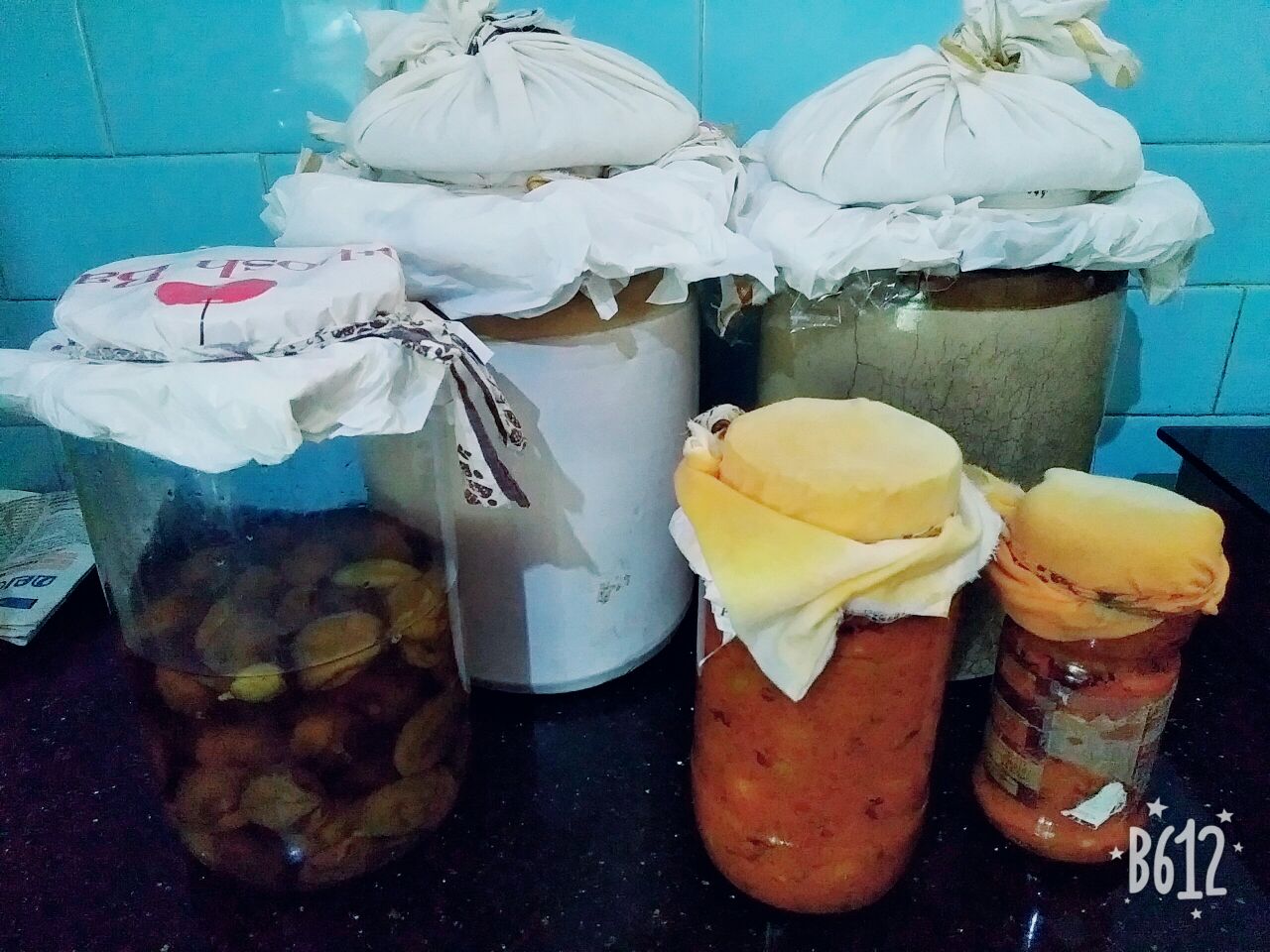
The photo shows jars of “Kadumanga”, a pickle delicacy made from seasonally available tender mango, much earlier than they really mature, ideally ranging from grape-size to a little bigger than a lemon. Nothing artificial; only naturally occurring ingredients go into the making of the pickle. Wash, drain and wipe the baby mangoes dry; these should preferably be a more sour type of mango, with the bunches still intact, and the fruit broken off from the stalk and dropped right into the jars together with the sap, then layered with crystal salt. The sap, along with the salt, is the secret to successful preservation. Seal the jars, ensuring they are airtight, and shake the jars every day. After about ten days, add spices like chilly, mustard and asafetida, all well powdered, to create a titillating effect for your taste buds. Also add boiled gingelly oil once cooled off to lock in the developing flavors and extend the shelf life virtually indefinitely. A lesson in microbiology: sterilize your utensils in the sun first. This way there is no moisture for microbes to grow in.
I like to think Arundhati Roy and Salman Rushdie both had their novels “pickled” to further their chances of winning The Booker Prize.
Roy’s The God of Small Things frequently references Paradise Pickles and Preserves, a pickling company ran by Mammachi in an attempt to preserve the past.
 Midnight’s Children by Rushdie contains these lines about the “Symbolic value of the pickling process: all the six hundred million eggs which gave birth to the population of India could fit inside a single, standard-sized pickle-jar; six hundred million spermatozoa could be lifted on a single spoon. Every pickle-jar (you will forgive me if I become florid for a moment) contains, therefore, the most exalted of possibilities: the feasibility of the chutnification of history; the grand hope of the pickling of time!”.
      What makes those pickles stand apart from the rest?  The only unique selling point (USP) I can think of is this: to the secret condiments were added indispensable intangibles, feelings of love, care and affection – all the qualities that truly make a grandma a grandma.

Monday, March 19, 2018

I will knead you into a lovely full moon

    “Give me a place to stand, and a lever long enough, and I will move the world.” So said Archimedes once. I wish I could say, in the same vein: “Give me some wheat flour and a rolling pin, and I will move hearts.

        Water, salt and little else besides - just mix everything until well combined. Knead the dough into the desirable consistency, and then turn it into lovely shapes and sizes before baking these into anything you can name. Just like clay in the hands of a skilled potter, you can give your creativity free reign and shape, size, flavor up and color the dough, baking it into something beyond anyone’s wildest culinary fancy.
Our love affair with wheat is said to have started between 12,000 and 10,000 BCE. It was in the Fertile Crescent, where Mesopotamian, Assyrian, and Egyptian farmers first began cultivating wheat. Obviously, the bread we now eat took millennia to develop into what it is today. The loaves our ancestors baked were definitely harder, less refined, and coarse, but most likely also much healthier, for the ancient ones ate flour far less removed from the original, wisely preferring not to cater to the taste buds alone.
Baked in the fire of maternal love, my mom used to place before me three full moons to fuel my day’s labor. Evenly rounded paper-thin, well-raised pita bread, straight from the chapatti stone. The steam soon found a hole to escape through, and the pita bread deflated adjusting itself to the serving dish. The virtual taste of that aromatic odor in itself was rousingly appetizing. It would always remind me of the hymn lyrics that ran something like “I am the living bread that came down from heaven; anyone who eats of this bread shall live forever”.
It is a fact that man cannot live by bread alone. So my practical and pragmatic prayer for you, in the words of Nelson Mandela, is: “Let there be work, bread, water and salt for all.” However, I tend to smile in remembrance of Omar Khayyam: “A loaf of bread, a jug of wine, and thou”.

Wednesday, February 21, 2018

You Made My Day Dear...

Today is my 38th birth anniversary, to be more careful with the language as my resolution for the new year was to. I'm feeling overwhelmingly happy after an outpouring of good wishes that started yesterday already, one of the well-wishers being my beloved director at my erstwhile training college. I had never thought he cared that much about me.


 I stayed up late last night talking to a terrific friend of mine. You know, I overslept as a result of that and missed my breakfast, yet I went to work with a heart filled to the brim.
          I tend to lie awake cuddled up in my comforter before I really get up in the morning. There was a toddler crying in a nearby apartment. I can't stand kids' crying and was wondering why her parents were just letting her cry. Why couldn't they hug and kiss her to console her? As she continued, I imagined walking up to her and hugging her, kissing her on the head, calling my Aishumol to mind. To my great surprise, the toddler immediately stopped crying. I pricked my ears and listened carefully, but not a sound was heard from her again.
       Musing over it and in haste, I left for my office on an empty stomach. However, it turned out to be fortuitous. I am a huge fan of breakfast - the bigger, the better, since that way I won't have to bother about lunch or dinner. As I got to work, my colleague Mazhar from Bangladesh had a surprise in store for me. He presented me with a slice of pizza which  Bhabhi had made. I promptly wolfed it down. It was a veritable feast, far better than a birthday cake. What more could I ask for my birthday?

Sunday, January 28, 2018

After a Long Period of Time...

Recently, when I was talking to someone I did my M A with at Department of English, Calicut University Campus, all these came up to my mind. I was transported back to my university days. It was on a lazy after noon, I was  talking to one of my classmates. Now I am not quite sure what she was talking about. I only knew it was something a teacher had mentioned during the previous hour. I had skipped that particular session, though I wasn't in the habit of missing classes. I told her very casually: "Oh, I missed that period." "You missed WHAT? You missed a PERIOD?" she echoed dubiously, looking rather amused but not pursuing the matter. Nor did I care, as naivety was my second name back then. Maybe, even now at times for sure.

One of the in-house English words I knew from the school I went to was "period". We would say "first period", "second period", "during  the PT period" etc. To me it simply meant a class session lasting 45 to 60 minutes.
As I grew older, I joined BA English and had  British History on our syllubus. The professor said the Victorian period  began in 1837, the year Queen Victoria became Queen, and her period lasted until 1901, the year she died.I had no difficulty conceptualizing a longer timeframe than the one I had used at school, by putting millions of them together. But I still think Victoria must have been an amazing woman to stay in power for such a long period , especially at a time when political assassinations were very common among the European royalty. Even the venerable queen herself had escaped many attempts on her life during her unusually long reign (or shall we call it "period in power").
That wasn't the end of it. Fast forward to the present, and I am working in a foreign university with teachers from about 17 nationalities. In the register we ELT professionals use here, what we mean by  'period' is just a full stop. It is one of the words I have to use frequently when teaching Academic Writing Skills. Most of the text books we use are corpus-informed, based  mainly on North American English. Not sure what will happen next in the Life of Period.