Sunday, December 24, 2023

A Breakfast with Elements at the Heights of Habla

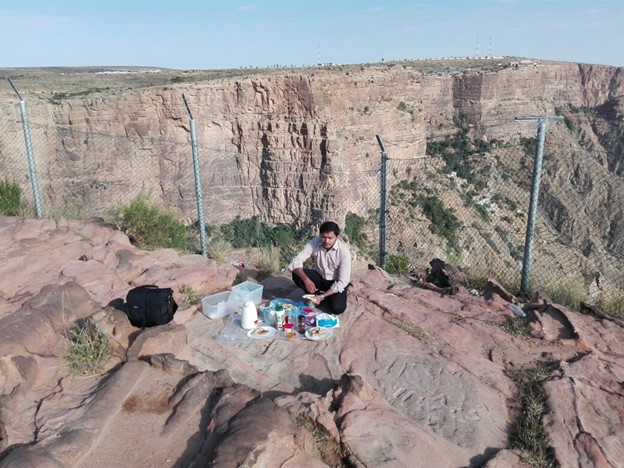
       There was a time when I lived in a sleepy, cold town all alone, having the luxury of a lovely friend, a small car, and a camera. We roamed around the places, exploring things no mortals we knew ever dared to. Once, he came up with a plan to watch the sunrise and had breakfast sitting on the top of a huge boulder, crowning the edge of a mountainous height and cutting steep slope that people feared to peep down. The mountain peak known as Habla is one of the peaks on the Aseer Mountain range, which is part of the Sarawat Mountains, running parallel to the Red Sea’s eastern coastline, extending the Hijaz Mountain range to the Southern borders of Saudi Arabia.


     Part of the plan was to start way earlier so that we could watch the sunrise, and December was never kind to the people of this part of the world. Being so precarious and knowing much more about what was happening around me, I said no without sounding blunt. Still, I had to follow his mind; what happened afterward was a once-in-lifetime experience. It was rather like meditation. And a simple but sumptuous breakfast. My crazy friend had packed everything diligently to keep it hot as the weather was chilling, and the cold breeze never stopped blowing on our faces, facing the sun for mercy.

     A strange, mystic sort of elevating experience swept us into an unearthly trance. Maybe because it was a Friday morning, all the monkeys remained in the cliffside holes, usually fast asleep, daring not to disturb my Buddhist Sufi, Erich Beer.

      Here’s a word about breakfast. As one of the main three meals of the day, breakfast has always been stressed as more important than the other two. The saying goes like eat your breakfast like a king, lunch like a queen, and dinner like a beggar. However, I recently heard about a book being reviewed on BBC World that says breakfast is a dangerous meal. I don’t know why. Nor did I dive deeper into it to get to know it. It may be a cognitive bias that I don’t want to believe that story, even if the author succeeded in convincing me otherwise.

Friday, December 1, 2023

The Earth in Her Hands

 The Earth in Her Hands is a book by Jennifer Jewell that covers 75 extraordinary women in the world of plants. It tells us stories of womenfolk who put their life into plants, or the plants chose them to live their life with. Like most exciting things happening in my life, I stumbled upon this title recently while researching a related project online. It was love at first sight, and I got addicted to it while listening to the book on Audible, waiting outside our university dental clinic for my wife to have an appointment. Thanks, Dr. Abdul Qadar, for a three-hour long session on an emergency basis before he leaves for his home for the annual vacation.


Each woman has a unique plant journey to relate to, which will take us for a ride through the ever-exciting botanical world. They are cherry-picked from various fields like botany, garden nursery, floral design, garden, photography landscape architecture, farming, seed banks, herbalism, and food justice. The common thread all these extraordinary lives share is their love for plants. The book has interestingly featured a bold lady from India: Vandana Shiva. She is known as Gandhi of Grain.

Back where I work, the Saudi Green Initiative and Middle East Green Initiative are already on the way to regreening the desert. Saudi Arabia is planting 10 billion plants to help regreen a joint target of 40 million hectares of degenerated land. For a country almost the size of Western Europe and with 2320 miles of untouched shorelines, finding space for these 10 billion is a piece of cake. But watering them can be the only challenge with poor rainfall.

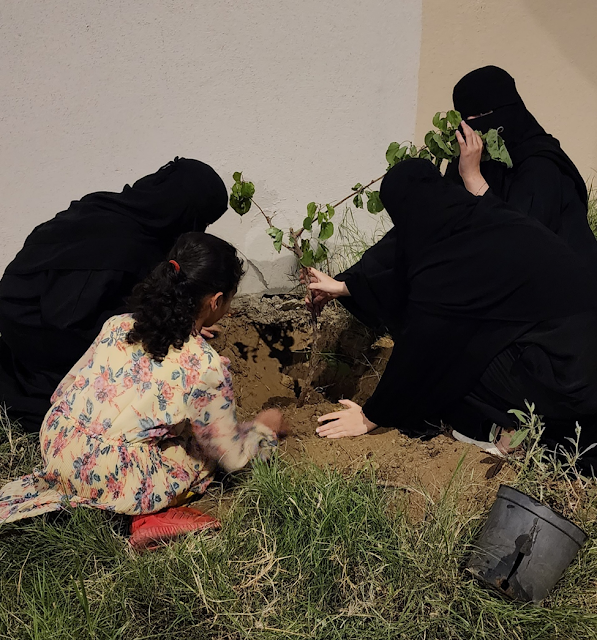
We started challenging ourselves to pick up the litter down the street and clear the undergrowth first. Then, we visited a few nurseries to collect the plants on our list with just two conditions: they must bear fruits edible to men or birds. And it should grow independently once it has established itself fully rooted out. It may last a lifetime, being drought-resistant and winter-hardy. During our nursery visits, we made some compromises, fearing the price tag and being inadvertently influenced by the winning eloquence of the man in charge to sell the least moving and most profitable items in stock. Our behavioral economics is still in its infancy, no matter how educated we think we are. We collected manure from the sheep farms, got help digging the holes and planted by calling anyone available.

My Saudi neighbor Yahyah and his wife Jawahirah looked more enthusiastic about it than I did. I just took the initiative, but they seemed to be doing the rest of the work, like setting up drip irrigation pipelines and extending the work to the next level, traveling around to look for more and better cultivars for their garden space and beyond. Indeed, as the Chinese would say, the best time to plant a tree was 25 years ago, but the second-best time is now.

Thursday, August 10, 2023

Where have you all been?

          We have been missing those lovely, feathered friends for a while. We all wondered where all our birds had gone to. Yesterday, as I was helping an uncle prune his garden, I had a realization for an obvious reason. The peaches and figs in his garden have been left mostly unharvested. As the orchard was well-walled, no one dared to step in, and the birds would in no way be prosecuted for fruit poaching. They must have been feasting on it. There were too many fruits fallen and rotten under each. The season’s harvest is too big for little birds to devour. And they can’t squirrel it away for winter. The ground was littered with a rainbow of rotting fruits, the sweet scent of decay filling the air.

We had grown friendlier ever since we moved in, and they seldom flew off even when we walked closer. We moved in the winter; at a time, they were desperately looking for food. My wife readily sensed a need and kept a bowl of grain and water in another one against the wall. They were happy and Umar was the happiest at sighting them early in the morning.

And those days, our paved yard hosted many parties within its walled privacy under the starlit sky by our family and friends in our neighbourhood. It can be birthdays, ifthar, a weekend get-together, anniversaries, holiday events or even just friendly dinners. They were usually at night and the partying would go on till early morning around a campfire. The kids would dance around the fire lit in a purpose-built iron box caring not to come too close. The interesting thing is that there will be another feast for birds on food crumbs, scraps, and tidbits left over early in the morning. The fallen morsels from rice dishes will dry back to raw grains and these sparrows will clean up the floor for the next event.

As our little Azadi fig tree started fruiting, they were the first to claim it. Azadi is the name we fondly call it for it was a gift from a South African colleague Azad Hayat as we moved in. The birds were quick to notice the ripe time and didn’t wait for us nodding permission. As my mom would say, the fruit goes to those who first claim it. Therefore, we left the unfinished fruit on the plant for them to feast on, part by part taking turns. Thank you, lovely birds, for showing up this morning to wish us our 15th anniversary.

Friday, April 7, 2023

Seeding the silk route feeding on a humble plant…

        Around 7000 years ago, the Chinese invented the art and science of spinning cocoons of silkworms into smooth thread and weaving it into the lustrous fabric for the fabulously rich world. They raised silkworms feeding on cultivated white mulberry plants. The secret was successfully guarded for thousands of years and resulted in one of the largest travel and transport networks, later known as the silk route, over land and sea. Traders travelled to distant lands on foot, on horseback or by caravan, following a confluence of trails leading to China, and brought the silk and sold it at bazaars and caravanserais en route. (Caravanserais were roadside inns where travelers – caravaners - could rest and recover from the day's journey.) The route connected the civilizations in the East and the West for about 1400 years.
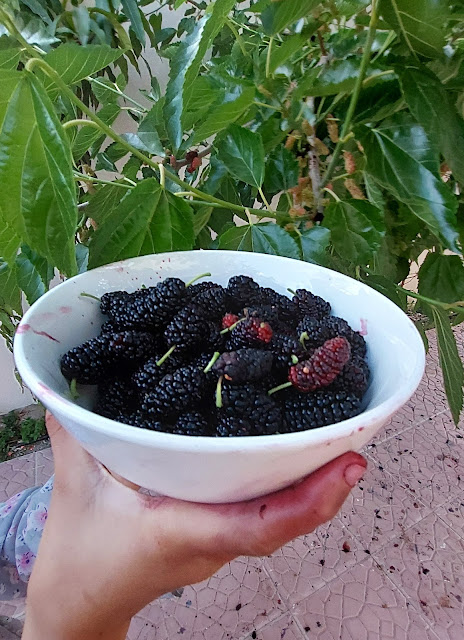


I captured this photo of our daughter Aishah holding a bowl of sun-ripe mulberry freshly plucked  in the little garden of our property owner, Abdul Azeez Abdullah Yahya Ajeem, a man with truly green fingers. He had planted this mulberry tree a few years before I rented an apartment on the ground floor. Reading my interest in plants, he readily entrusted the care of his plants to me.

Back to our silky story. Chinese rulers sent gifts of silk to their counterparts in Persian and other West Asian countries then, spreading the fame of silk further west. The custom of handing out free samples is as old as silk itself. My mom seemed to know this as she used to send a glass of milk to each house in the neighborhood every time her cow had a calf, often landing orders for a regular supply of one or two glasses of milk every morning or evening until the cow stopped lactating. The only difference is that she did not differentiate between potential customers and the rest.

About the time of Jesus Christ, it became fashionable among the rich and powerful to wear silk, the Roman rulers setting the trend. The countries along the silk route also got their share of bounty in the form of road tax and silky gifts in return for the safe passage of their costly merchandise. The Kushanas, who then ruled north, central, and northwest India, became very prosperous, having their centers in Mathura and Peshawar. Their ports at the mouth of the Indus were used to ship silk to the Roman Empire. As Peter Frankopan put it: “Money, rather than men, began to be used as currency for trade with the East.” Naturally, the Kushana’s gold coins became the currency in circulation along the route.

Colin Thubron wrote in his Shadow of the Silk Road: “To follow the Silk Road is to follow a ghost. It flows through the heart of Asia, but it has officially vanished leaving behind the pattern of its restlessness: counterfeit boarders, unmapped peoples. The road forks and wanders wherever you are. It is not a single way, but many: a web of choices.”

Of late, China - being a world power - revived its interests in silk routes and began diplomatic negotiations to build such a mega network connecting the world much better. Thus, the Silk Road Economic Belt and the Maritime Silk Road were born, which were successful to an extent. These were obviously meant to export their product and sell them on the world market, much more aggressively than in their mulberry days.

It is rather astounding that a humble worm – the silkworm – feeding on a humble plant – the mulberry bush – could have given rise to a global industry. It is equally astounding that the Chinese, who discovered the origin and potential of silk, could guard their secret for so long. Their trade secret would not have lasted nearly as long in modern times. I wonder if Europeans had an inkling of the origin of silk, when the English nursery rhyme saw the light of day: “Here we go round the mulberry bush, The mulberry bush, The mulberry bush. Here we go round the mulberry bush, On a cold and frosty morning.” My guess? No. The mulberry bush in the nursery rhyme could have been any old bush brave enough to survive the English climate. Luckily, the Chinese recognized its worth and knew it was not just “any old bush”.
Saturday, March 11, 2023

Cows without cowboys…

People in the Arabian Peninsula were largely pastoral in their culture. Livestock was one of their mainstays. Cattle, sheep, goats, and camels were a part of their tribal lives. Interestingly, there are over 100 words for camels in the Arabic language, just as Eskimos have more than two dozen words for snow. The animals they kept gave them milk, meat, leather, manure to cultivate their crops, and a pet to take care of or play with. Camels were their only cars until not too long ago. Milk is still an important item on Saudi tables, and they know a lot of dishes with dairy. It is also worth noting that in desert dwellers’ long history with milk, their genetics have favored them to have comparatively few cases of lactose intolerance. There are still very rich people who take more pride in the number of sheep or camels over the luxury cars or assets in real estate they own.


This herd of cattle belongs to the Bos Indicus breed, characterized by humped shoulders and pendulous dewlap. It is hard finding them on commercial dairy farms but not a hard job to locate them roaming around in the countryside. Saudi Arabia is home to a few mega dairy farms like Al Marai, Nadec, Al Safi etc. to cater to the dairy needs of the people who were traditionally shepherds before petroleum became a major source of income. These megafarms have hundreds of thousands of Bos Taurus milking cows, crossbred over many years for optimum milk production.

            This shot was taken at the back of a shopping center right in the middle of a busy city in Saudi Arabia where we would never expect to see them grazing. A flock of sheep with a shepherd is a common sight here, but not a herd of cattle like this. They roam around during the day, finding shelter under a tree or the deserted ruins of a building, or by a wall-side, taking rest and regurgitating while the sunshine is getting hotter; by sunset they go home on their own, following their herd instinct.

          As I was born and brought up in a subsistence farming family, I easily relate to them. My mom raised cows for a long time, and my dad had a trip of goats ever since I can remember, till he passed away. You could say goats and cattle are in my blood and DNA, even though I am now a cowboy without a cow to call my own. Luckily, I can enjoy the presence of herds almost on my doorstep.