The Earth in Her Hands is a book by
Jennifer Jewell that covers 75 extraordinary women in the world of plants.
It tells us stories of womenfolk who put their life into plants, or the plants
chose them to live their life with. Like most exciting things happening in my life,
I stumbled upon this title recently while researching a related project online.
It was love at first sight, and I got addicted to it while listening to the
book on Audible, waiting outside our university dental clinic for my wife to
have an appointment. Thanks, Dr. Abdul Qadar, for a three-hour long session on
an emergency basis before he leaves for his home for the annual vacation.
Each woman has a unique plant journey to relate to, which will take
us for a ride through the ever-exciting botanical world. They are cherry-picked
from various fields like botany, garden nursery, floral design, garden,
photography landscape architecture, farming, seed banks, herbalism, and food
justice. The common thread all these extraordinary lives share is their love
for plants. The book has interestingly featured a bold lady from India: Vandana
Shiva. She is known as Gandhi of Grain.
Back where I work, the Saudi Green Initiative and Middle East Green
Initiative are already on the way to regreening the desert. Saudi Arabia is
planting 10 billion plants to help regreen a joint target of 40 million
hectares of degenerated land. For a country almost the size of Western Europe
and with 2320 miles of untouched shorelines, finding space for these 10 billion
is a piece of cake. But watering them can be the only challenge with poor
rainfall.
We started challenging ourselves to pick up the litter down the
street and clear the undergrowth first. Then, we visited a few nurseries to
collect the plants on our list with just two conditions: they must bear fruits
edible to men or birds. And it should grow independently once it has established
itself fully rooted out. It may last a lifetime, being drought-resistant and winter-hardy.
During our nursery visits, we made some compromises, fearing the price tag and being
inadvertently influenced by the winning eloquence of the man in charge to sell
the least moving and most profitable items in stock. Our behavioral economics
is still in its infancy, no matter how educated we think we are. We collected
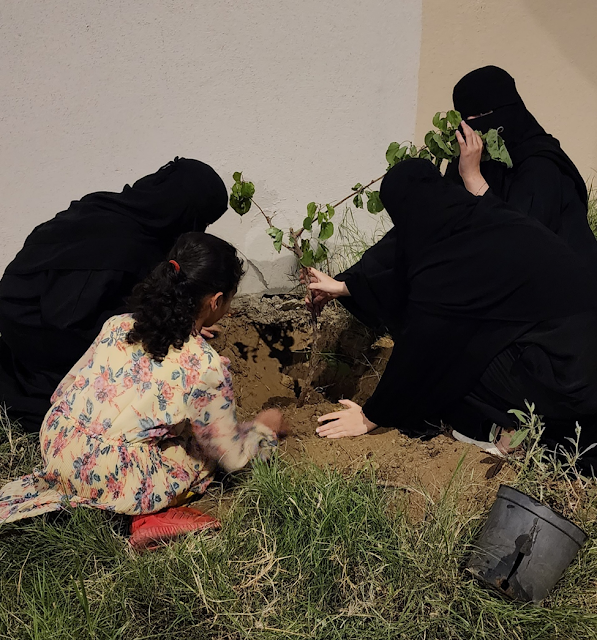
manure from the sheep farms, got help digging the holes and planted by calling
anyone available.
My Saudi neighbor Yahyah and his wife Jawahirah looked more
enthusiastic about it than I did. I just took the initiative, but they seemed
to be doing the rest of the work, like setting up drip irrigation pipelines and
extending the work to the next level, traveling around to look for more and
better cultivars for their garden space and beyond. Indeed, as the Chinese
would say, the best time to plant a tree was 25 years ago, but the second-best
time is now.